
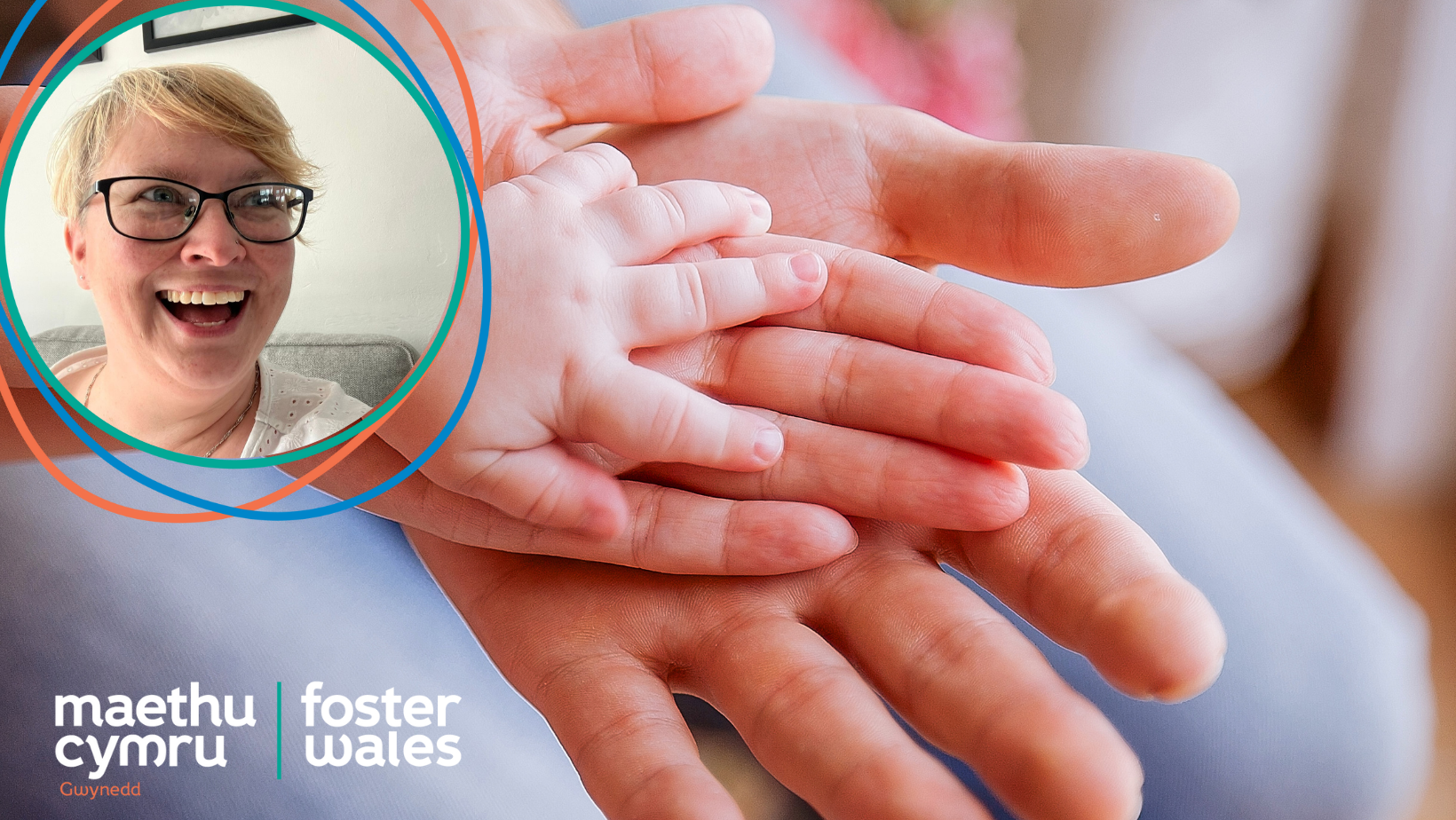
After many years working in a children’s home, where she gained firsthand insight into the challenges children face, fostering was never far from Beth’s mind.
She went on to qualify and work as a social worker but soon found herself missing the daily, face-to-face connection with the children that had first inspired her.
In 2012, she became a foster carer with Maethu Cymru Gwynedd, bringing compassion and experience to every child in her care and fulfilling the meaningful work she has always believed in.
Now, her home is a safe haven for the tiniest of arrivals – caring for young babies in their earliest weeks of life – while at the heart of it a lively ten-year-old and a two-year-old toddler, who are with her long-term.

here’s Beth’s story…
where it began: my first steps into fostering
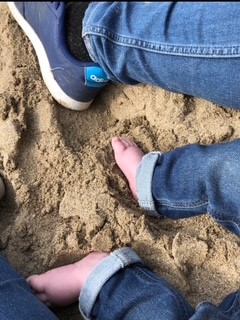
As a full-time worker and single foster carer, Beth began by offering short breaks (respite foster care) to support other local foster carers while balancing her own commitments.
“After about a year of one little boy coming to me for short breaks, I was asked if I would take him in on a long-term basis”, Beth explains.
“I continued working full time, and the timing worked out well since the little one was just starting school when he came to live with me permanently.
“My long-term plan had always been to focus solely on fostering, with the aim of offering a home for one child on a long-term basis while also fostering babies prior to adoption, but I needed a little nudge to take the plunge and give up work.
“Then COVID hit, and it put everything into perspective. I remember when the schools closed – being a key worker, my little one still had to attend school with the other key workers’ children. I took him in on that first day, saw the teachers in full PPE, followed by the frightened look on his face and I just remember thinking, ‘he needs to be at home with me.’
“It felt like the right time to step back and focus fully on him and our future together. It took another couple of months for me to leave work, but it’s a decision I’ve never regretted.
“Since finishing work, he has continued to live with me, and I’ve cared for many babies and toddlers on a short-term basis. I currently have two under the age of two – one of whom is now with me long-term.”
I don’t foster alone: the vital role of support
When you foster with your local authority, you’ll have a local team supporting you and encouraging you every step of the way so that you never feel that you’re fostering on your own, even if you’re a single carer.
“I’ve been lucky to have such supportive social workers and a reliable team at my local authority, backing me throughout my fostering journey,” says Beth.
“They’re brilliant, they’re local and really hands-on.
“Just the other day, while I was taking part in a webinar, my social worker looked after my two youngest.
“They are a creative team that always finds practical solutions when things get logistically challenging!”
fostering with support: the role of community, friends, and family
Friendships often develop naturally through fostering. These connections provide valuable emotional support, practical advice, and a sense of community, helping foster carers like Beth feel understood and less isolated.
“I go to our regular coffee morning groups and have become friends with other local foster carers who look after children around the same age.
“We go to baby groups together, grab a coffee while the kids play, and support each other – whether it’s borrowing baby equipment or sharing advice. We’ve got a WhatsApp group where someone’s always ready to help!”
“Although my parents don’t live nearby, they always help out when they visit – they love taking my eldest foster child out for the day! During the school holidays, we go to stay with them, and they absolutely adore the children.
“My mum especially loves knitting cardigans for the babies! We FaceTime almost every day to keep the children connected to them – they take on the role of surrogate grandparents!
“I’m also lucky to have good friends who step in to help whenever I need. They particularly enjoy the baby cuddles, but I know there’s been numerous times over the years that their practical support has made life so much easier. The children love spending time with them too and view them as extended family.
“While I prefer to lean on support from friends and family instead of respite care, I know that respite is available and can be a helpful option if I ever need it.”
getting too attached: why it matters

Attachment is a crucial part of fostering, as it helps children feel safe and wanted after experiencing uncertainty or trauma. Building strong bonds with foster carers provides children with the emotional stability they need to develop trust and grow – even though saying goodbye can be one of the hardest moments for a foster family.
Beth shares why she believes attachment is at the heart of foster care.
“This is something I am deeply passionate about and the main reason I wanted to foster babies.
“Building secure attachments with them as newborns helps set them up for building positive relationships throughout their lives. It’s so important.
“It’s emotional, of course, because you do get incredibly attached, but they absolutely deserve that attachment. That’s how it should be.
“You have to go all in and fall in love with them, nurture them as your own, and surround them with the love and care every child deserves.
“Of course your heart breaks when they leave – if it didn’t, you wouldn’t be doing it right.But from the start, there’s an understanding that you may only be in their lives for a short time – and that role is incredibly important. You’re helping to prepare them for what comes next.
“It’s a bittersweet experience.
“I’ve seen babies go on to be adopted and have built wonderfulrelationships with their adopters. Watching those babies successfully transfer their attachment and seeing those families grow and settle has been truly magical.
“I’ve also seen children return home, which is always the ultimate goal in fostering.
“There’s real joy in witnessing families turn things around and come back together.
“People often say they couldn’t do fostering because they couldn’t give the children back – but they’re not ours to keep.
“We have the privilege of loving and nurturing these little ones for as long as they need us, but we’re often just a small part of their story. But you can’t hold back, because they deserve your full love.”
“they need to know how important and precious they are, even if it’s only for a few days, weeks, or months”
when babies leave: helping my long-term foster children understand and cope
Fostering babies alongside older, long-term foster children can bring some emotional challenges, especially when it’s time for the babies to return to their birth families. Older children may feel confused or upset, particularly if they haven’t been able to return home themselves – something Beth has witnessed with her own foster children.
“My eldest foster child, who is autistic and sometimes finds it challenging to understand certain situations, has asked questions like, “why can’t I go home?” or “why can’t my mummy do that with me?” when he sees babies return to their birth families.
“And when babies – especially those who’ve been with us for a long time – move on to adoption, it can also be unsettling, often leading to worries that he might have to leave one day as well and go to live with a new family.
“It can be a confusing and emotional time for him. Of course, he misses them terribly too.
“But I support both of my long-term foster children by helping them understand that every child’s journey is different, reassuring them that their place in my home is safe and secure.
“And as time has passed, as the oldest has seen babies come and go and now seen another join us ‘forever’, he has come to realise that they are here to stay – and that they’re now ‘brothers’!”
parenting in foster care: understanding the impact of trauma
Children entering foster care have experienced some form of trauma, even the youngest babies who were separated from their mothers just days after birth.
Because of this, they require a different approach to parenting, which Beth believes is not something to fear, but something to understand and appreciate.
“The training you receive from your local authority, full of interactive sessions with fellow foster carers, will equip you to support them effectively,” she added.
routines that work: creating stability for children of all ages
Routines are essential for building stability and a sense of security in a home with foster children of varying ages and needs, providing them with comfort and support during times of change – something Beth deeply understands.
“With having both young babies and older children in my life, we rely on routines and keeping things predictable – especially since this consistency is even more important for children with autism.
“But our routines are flexible when needed, especially during school holidays when we adapt to a more relaxed pace, which I always look forward to – it’s nice to take the pressure off a little sometimes!
“I tend to keep things simple during the school holidays by avoiding too many big days out, which can be overwhelming for foster children, and instead focus on enjoying everyday moments together.”
“our home is their safe place and sometimes that quality time together without too many distractions is just what they need”
the best part of fostering? the little moments

When reflecting on what makes fostering so meaningful, many foster carers highlight something simple yet powerful – the little moments that bring smiles and joy. As Beth says:
“What I love most about fostering is seeing the children flourish and develop.
“It’s the small achievements – like sitting at the table to enjoy a home cooked meal or walking around the supermarket next to the trolley, rather than having to sit in it, or when they find joy in something new, or discover a new skill – that mean the most.”
“these everyday moments might seem ordinary to others, but to a foster child and me, they mean everything”
opening the door: overcoming barriers to start fostering
Beth’s advice?
“If fostering is something you feel passionate about, start by talking to your local authority.
“Remember, that what you see as barriers might not actually be barriers – there are usually solutions.
“As a single foster carer working full-time, I have been able to make fostering work successfully with the support of my local authority team in Gwynedd.
“And having worked as a social worker and understanding the system, fostering with my local authority is the only choice I would consider.”

could you foster with your local authority, like Beth?
If you live in Gwynedd, contact Maethu Cymru Gwynedd and a member of our dedicated team will be in touch for a friendly, no obligation conversation to help you decide if fostering is right for you.
If you live anywhere else in Wales, visit Foster Wales for more information and to find your local authority fostering team.